- Vision Leadership for Life Newsletter
- Posts
- The Cost of Black Male Leaders Internalizing Other People's Discomfort
The Cost of Black Male Leaders Internalizing Other People's Discomfort
Vision Leadership for Life Newsletter

Dominic George
February 21, 2026

SPONSORED BY VISION LEADERSHIP FOR LIFE
Navigating Your Leadership Journey: Tailored Tips for Black Men in Mid-Level Roles
By Dominic George · February 21st 2026
Happy Saturday! Word Count: 1579…12.09 minutes. Copy edited by Dominic George
Welcome to this week’s edition of the Vision Leadership for Life newsletter, designed with the specific challenges faced by Black men in mid-level leadership positions in mind. We understand the unique journey you’re on, and our goal is to provide practical insights to help you thrive in your professional evolution. So, lets dive into today’s topic and Elevate Your Leadership.
The Cost of Black Male Leaders Internalizing Other People's Discomfort

There is a quiet cost many Black men pay as they move from mid level management into senior leadership. It is rarely discussed in performance reviews or succession plans. It does not appear in compensation packages. Yet it shapes confidence, decision making, and long term career trajectory.
It is the cost of internalizing other people’s discomfort.
You recognize the moments. You adjust your tone because direct feedback may be interpreted differently depending on who delivers it. You hesitate before challenging an idea because you do not want to be perceived as difficult. You over prepare for meetings where your qualifications are already established. You carry the weight of making sure others feel at ease in conversations that stretch beyond their lived experience.
At first glance, these behaviors can look like executive maturity. Senior leadership requires emotional intelligence. It requires awareness of how communication lands across diverse audiences. It requires calibration.

The Issue Is Not Calibration. The Issue Is Internalization
Calibration is strategic. Internalization is psychological. Calibration says, I understand the context and I will choose my response intentionally. Internalization says, if someone is uncomfortable, I must be the cause.
Over time, that assumption shifts how you show up.
You may begin to edit ideas before they are fully expressed. You may downplay ambition to avoid being labeled overly aggressive. You may avoid naming systemic dynamics because you fear being viewed as divisive. None of these decisions happen in isolation. They accumulate.
A balanced view requires acknowledging that professional environments operate within shared norms. Every leader, regardless of background, must adapt to organizational culture. Senior leadership requires the ability to read stakeholders, anticipate reactions, and manage complexity. In some cases, feedback about tone or delivery is accurate and developmental.
At the same time, cultural differences in communication styles are real. Research across industries demonstrates that assertiveness, directness, and urgency are interpreted differently depending on the speaker. Leaders from underrepresented backgrounds often carry an additional layer of scrutiny. Both realities can coexist without framing the issue as conflict.
Balanced Leadership Requires Discernment
The cost emerges when discomfort that originates in difference is absorbed as deficiency.
I have coached Black men who have increased revenue, secured significant philanthropic funding, strengthened retention metrics, and rebuilt team culture. Their track record is measurable. Yet they question whether they are truly ready for senior leadership because a stakeholder once described them as intense or too direct.
The data does not support the doubt. The doubt persists because discomfort was internalized.
This pattern is common during the transition to senior leadership. At mid level, you are rewarded primarily for execution. At senior levels, perception and influence carry greater weight. You begin to observe informal networks, unspoken expectations, and subtle cues that shape advancement. Without disciplined self evaluation, it is easy to conclude that the path forward requires becoming less visible or less direct.
That conclusion is rarely grounded in evidence.
A practical approach is to separate feelings from facts. When discomfort surfaces in a room, ask: What specifically was said or done? What measurable outcome was affected? Is there consistent feedback from credible stakeholders pointing to the same issue? If the answer is yes, that is development. If the answer is no, that may be projection.
Balanced leadership requires discernment.
It is also important to acknowledge that not every uncomfortable moment is about bias. Sometimes growth requires refinement. Executive communication often demands brevity over detail, inquiry over advocacy, or strategic patience over urgency. Senior leaders who scale their impact do so by expanding their range, not by narrowing their identity.
The Difference Is Intent
When you expand your range, you add tools to your leadership. When you internalize discomfort, you subtract parts of yourself without conscious decision.
The subtraction is costly.
You may overwork to prove competence that is already evident. You may accept ambiguous criticism without asking for clarity. You may interpret silence as disapproval rather than neutrality. Cognitive energy that could be directed toward strategy becomes consumed by perception management.
Over time, this erodes confidence in subtle ways. You second guess decisions that align with your values. You temper standards that drive performance. You apologize for clarity.
ADVICE TIP FOR BLACK MEN: You are not responsible for regulating every emotion in the room. Separate emotional reactions from performance data. When discomfort surfaces, ask what specific behavior or outcome is being questioned and whether there is consistent evidence to support the concern.
Solution Shift:
In your next high stakes meeting, if feedback feels vague, respond with a clarifying question such as, “Can you point to a specific example or outcome so I can assess it accurately?” This immediately grounds the conversation in facts rather than assumptions.
Additional Tip for Black Men: Your leadership range can expand without your identity shrinking. Distinguish between refining your delivery and erasing your perspective. Growth requires adding tools to your communication style, not muting your values or lived experience.
Solution Shift: Identify one executive communication skill to strengthen, such as brevity in updates or structured storytelling, while keeping your core message intact. Practice it intentionally this week without altering your standards or convictions.
Expanding Range Without Shrinking Identity, For Black Men

Stepping into senior leadership requires a broader lens. You move from managing tasks to shaping direction. You are expected to influence cross functional stakeholders, navigate board level conversations, and translate strategy into measurable outcomes. With that visibility comes increased scrutiny.
Scrutiny is not inherently negative. It is a byproduct of responsibility.
The question is how you interpret it.
Strategic leaders learn to read the room without absorbing the room. They understand that discomfort can signal growth, disagreement, or unfamiliarity. It does not automatically signal error. They evaluate patterns rather than isolated comments. They seek clarity when feedback lacks specificity. They anchor their leadership in measurable outcomes and stated values.
This is not about ignoring impact. It is about evaluating impact objectively.
If multiple trusted stakeholders identify a communication gap, that data matters. If a single reaction surfaces without pattern or evidence, it deserves proportionate attention. Senior leadership maturity is the ability to hold both possibilities without defaulting to self blame.
From an organizational standpoint, diversity of perspective strengthens decision making. Senior teams that include varied communication styles and lived experiences tend to identify risk earlier and innovate more effectively. Diluting perspective to maintain comfort can unintentionally narrow strategic options.

Ask Direct Questions For Direct Feedback
At the same time, senior leaders must build coalitions. Influence requires trust. Trust is built through consistency, reliability, and demonstrated results. The goal is not to disregard how others experience you. The goal is to ensure that your evolution is intentional rather than reactive.
When I work with leaders through Vision Leadership for LIFE, the core principle is alignment. Advancement that requires self abandonment is unstable. Advancement that integrates identity with expanded capability is sustainable.
Internalizing other people’s discomfort accelerates instability. It fragments decision making and creates hesitation where clarity is required.
Releasing that internalization does not mean becoming rigid or dismissive. It means anchoring your leadership standards in evidence and values. It means asking direct questions when feedback is unclear. It means distinguishing between cultural difference and performance gap.
As you step into senior leadership, conduct an audit. Where are you adjusting strategically? Where are you absorbing unnecessarily? Which reactions are supported by consistent data? Which are assumptions?
Leadership is not about eliminating discomfort. Growth often involves it. The discipline is determining whose discomfort belongs to you and whose does not.
The cost of internalizing what is not yours is gradual erosion of clarity.
The benefit of discernment is sustainable influence grounded in integrity and measurable impact.
That is the transition that matters.
ADVICE TIP FOR BLACK MEN: Patterns deserve attention. Isolated reactions deserve proportion. Evaluate feedback based on repetition and credibility. One person’s discomfort does not automatically equal a developmental gap.
Solution Shift:
Create a simple feedback tracker. Over the next thirty days, document recurring themes from trusted stakeholders. If the same issue appears consistently, address it. If it does not, release it.
Additional Tip for Black Men: Advancement requires clarity, not self abandonment. Define your non negotiables before stepping into greater responsibility. Senior leadership will test your boundaries. If you have not defined them, the environment will define them for you.
Solution Shift: Write down three leadership standards you refuse to compromise, such as direct communication, data driven decisions, or equitable team expectations. Review them before major decisions to ensure your next move aligns with who you are becoming.
Closing Thoughts:

In summary, as you move into senior leadership, the challenge is not whether to adapt but whether you are interpreting every moment of discomfort as personal deficiency. Professional growth requires calibration and expanded range. It does not require absorbing reactions that are unsupported by evidence. The discipline is separating valid developmental feedback from projection, difference in communication style, or unfamiliarity.
If you are preparing for greater responsibility, audit where you are carrying emotional weight that is not tied to measurable outcomes. Clarify your standards, request specific feedback, and ground your leadership in data and values. Forward this to a leader who is ready to expand influence without shrinking identity.
That’s the new path forward.
Subscribe to the Vision Leadership for LIFE newsletter now for early access, if you want your insider tips, exclusive insights, and access to the strategies behind your leadership guidebook.
Get access to your leadership guide book by clicking this link: https://a.co/d/5M2eVzx
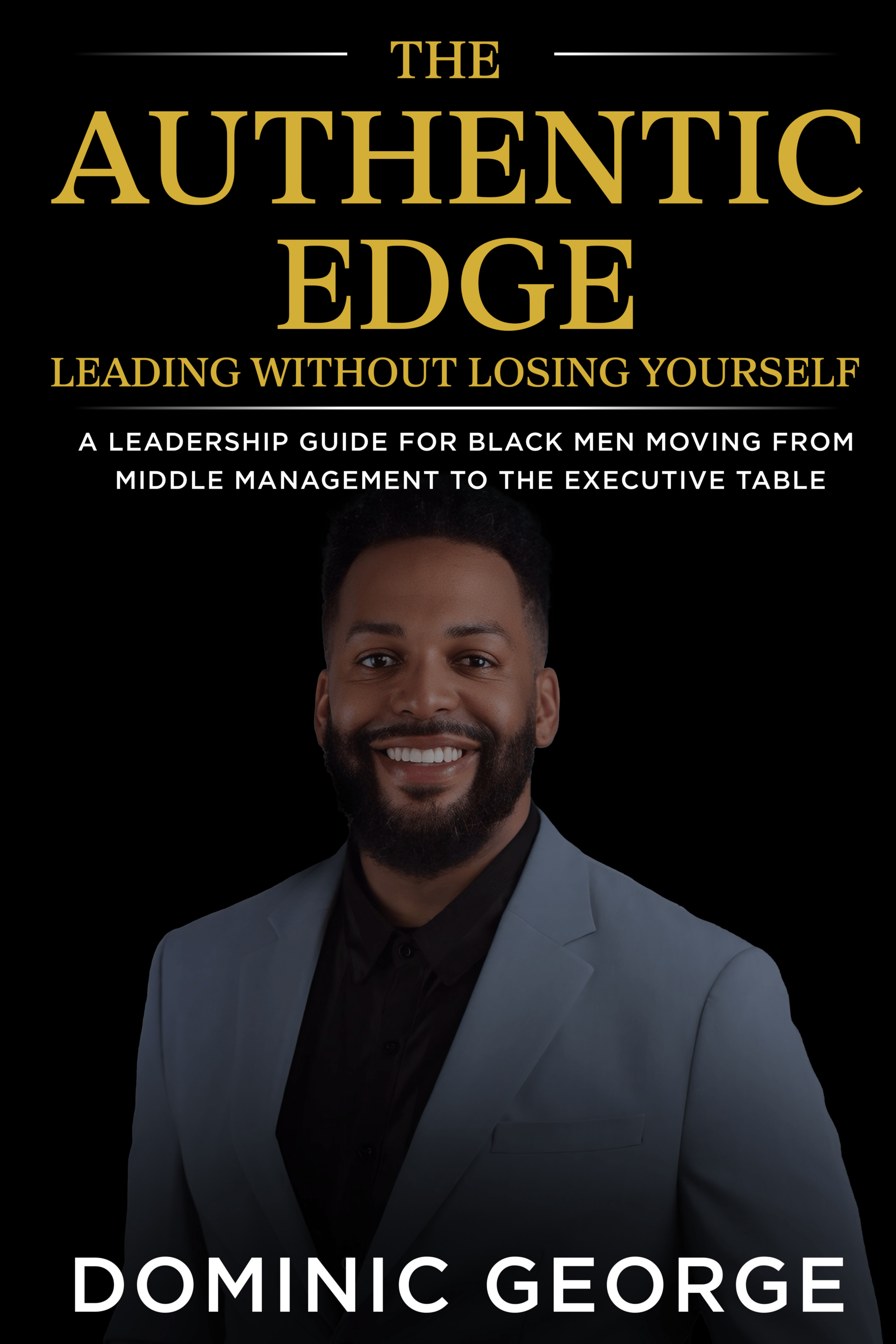
Fellas, your journey is both unique and powerful. If you’re ready to start leading from your authentic edge, then your on the roadmap for greatness. When you’re leading from within, you are not only advancing your career but also paving the way for future leaders.
Feel free to reach out for personalized coaching or share your success stories.
Your success is our shared triumph.
Real Talk: If you’re ready to:
Reclaim your voice in high-stakes spaces.
Lead with strategy, not survival.
Build a legacy that doesn’t require you to perform to belong.
You don’t have to lose yourself to lead. You just have to reclaim who you are, and lead from there.
Have a POWERFUL Day!
Dominic George
Founder, Vision Leadership for LIFE - LLC

Intellectual Property Notice:
© 2026 Vision Leadership for LIFE - LLC. All rights reserved.
The content, concepts, and original expressions in this newsletter are the exclusive intellectual property of Dominic George and Vision Leadership for LIFE, LLC. No part of this publication may be reproduced, distributed, or transmitted in any form without prior written permission. This newsletter is intended for personal development and leadership growth. Respect the work. Honor the source.
The Authentic Edge™ framework and related materials are proprietary to Vision Leadership for LIFE - LLC.